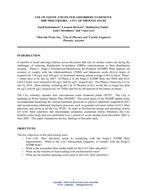
N-nitrosodimethylamine (NDMA) is a carcinogenic compound. The US Environmental Protection Agency (USEPA) has
estimated a 10-6 cancer risk level for NDMA in drinking water at 0.7 ng/L. Recent studies
demonstrated that NDMA is a disinfection byproduct (DBP) associated with the use of
chloramines. However, currently there is no USEPA approved analytical method for
determination of NDMA in drinking water. It is especially difficult at the required part-per-
trillion level concentrations, due to the small molecular size and polarity nature of
NDMA. In this study, an analytical method has been developed to accurately quantify Nnitrosodimethylamine
(NDMA) in drinking water using GC/MS, chemical ionization
with methanol, and Selected Ion Storage (SIS) mode. An ion trap mass spectrometer can
be used instead of a more expensive high-resolution mass spectrometer (HRMS) to
determine NDMA at ng/L levels. Solid-phase extraction (SPE) was used with Ambersorb
572 to isolate NDMA from water samples. Methylene chloride (500 uL) was used as
elution solvent. Good precision was obtained, with relative standard deviation (RSD)
less than 20%. The method detection limit (MDL) for SPE, using a 500 ml sample size,
was 1 ng/L. The calibration of data with R2 of 0.997, data from MDL studies, results
from commercial lab cross check, data from replicate reagent water samples, and real
water samples spiked with NDMA indicated that this method is acceptable for
determination of NDMA in drinking water. The advantages of SPE processes over
liquid-liquid extraction (LLE) processes were also discussed.
Includes 10 references, tables, figures.
| Edition : | Vol. - No. |
| File Size : | 1
file
, 290 KB |
| Note : | This product is unavailable in Ukraine, Russia, Belarus |
| Number of Pages : | 12 |
| Published : | 11/02/2003 |