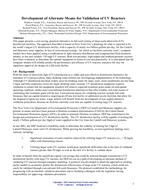
Anticipating implementation of ultraviolet (UV) for compliance with the upcoming Stage 2
Disinfection/Disinfection Byproducts Rule and the Long Term 2 Enhanced Surface
Water Treatment Rule (USEPA, 2003a), the US Environmental Protection Agency (USEPA) is in the process of drafting
guidance for implementation of UV disinfection [UV Guidance Manual, UVGM]
(USEPA, 2003b). This guidance will include recommendations for reactor design and
operation, dose tables, and a bioassay validation protocol. Because of the demonstrated
effectiveness of UV disinfection for controlling pathogens such as Cryptosporidium,
facilities with capacities ranging from less than 1 MGD to well over 1000 MGD have
expressed interest in UV as a pathogen control technology. In response, manufacturers
have developed reactors capable of treating in excess of 40 MGD. However, full-scale
reactor validation will be required before utilities will be awarded disinfection credits
because of the inaccuracies associated with scaling up validation data from smaller
reactor designs. Large scale validation presents numerous logistical challenges
including: an absence of test sites offering suitable water quality, sufficient volume
and discharge capacity; the need to produce exceptionally high levels of test
microorganisms for seeded validation studies; and, the difficulties of arranging for
NPDES permits for receiving waters. These needs were recently met by a UV
validation facility site developed at Portland, Oregon.
Bioassay validation of large reactors involves comprehensive characterization of
microbial inactivation through reactors under a range of operating conditions.
Depending on the doses examined and the indicator organism(s) used, microbial
reductions may reach 6 logs or more, requiring substantial concentrations of
microorganisms in the feed stream (possibly 106 or more viable microorganisms per
unit volume, with volumes dictated by the enumerative assay used to quantify microbial
reductions). UV reactor validation has traditionally relied upon the use of coliphages
and endospore-forming bacteria; however, validation of reactors with capacities
exceeding 20 MGD may require microbial seed concentrations in excess of 1014 per
minute. Achieving steady state feed conditions may require several minutes per test,
numerous conditions may be evaluated for each day of testing, and sufficient replication
must be practiced to characterize experimental variability; hence, total microbe
requirements may exceed 1016 per day, with enumerative assays consuming 3,000 or
more Petri dishes per validation. Moreover, the dose response of the seed organisms
must be determined at the bench scale to establish the microbial inactivation kinetics for
a given water. This paper discusses these considerations and examines the logistical
considerations for providing test microorganisms and conducting bioassay studies for
UV reactor validation at scales in excess of 20 MGD. Includes 3 references.
| Edition : | Vol. - No. |
| File Size : | 1
file
, 240 KB |
| Note : | This product is unavailable in Ukraine, Russia, Belarus |
| Number of Pages : | 6 |
| Published : | 11/02/2003 |