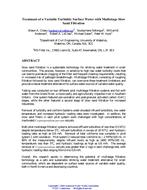
Slow sand filtration is a sustainable technology for drinking water treatment in small
communities. The process, however, is sensitive to high raw water turbidity levels that
can lead to premature clogging of the filter and frequent cleaning requirements, resulting
in increased risk of pathogen breakthrough. Multistage filtration, consisting of roughing
filtration followed by slow sand filtration, can overcome these treatment limitations and
provide a robust treatment alternative for surface water sources of variable water quality.
Testing was conducted on two different pilot multistage filtration systems and fed with
water from the Grand River, a municipally and agriculturally impacted river in Southern
Ontario. One system featured pre-ozonation and post-granular activated carbon (GAC)
stages, while the other featured a second stage of slow sand filtration for increased
robustness.
Removal of turbidity and coliform bacteria under elevated influent turbidities, low water
temperature, and increased hydraulic loading rates were investigated. In addition, the
slow sand filters in each pilot system were challenged with high concentrations of
inactivated Cryptosporidium parvum oocysts.
Both pilot multistage filtration systems achieved effluent turbidities of less than 0.5 NTU
despite temperatures below 5°C, influent turbidities in excess of 20 NTU, and hydraulic
loading rates as high as 0.8 m/h. Removal of total coliforms was complete in pilot
system 1 with ozonation. Pilot system 2 reduced total coliforms to 2 MPN/100 mL in
80% of the measurements, despite influent levels as high as 2400 MPN/100 mL,
temperatures less than 5°C, and hydraulic loadings as high as 0.6 m/h. The average
removal of Cryptosporidium oocysts was greater than 2 logs in each challenge test, with
hydraulic loading rates ranging from 0.4 to 0.8 m/h.
This research assists in determining the potential of multistage filtration
technology as a safe and sustainable drinking water treatment alternative for small
communities, which are dependent on surface water sources of variable water quality,
both in North America and developing countries. Includes 13 references, figures.
| Edition : | Vol. - No. |
| File Size : | 1
file |
| Note : | This product is unavailable in Ukraine, Russia, Belarus |
| Number of Pages : | 22 |
| Published : | 11/15/2004 |