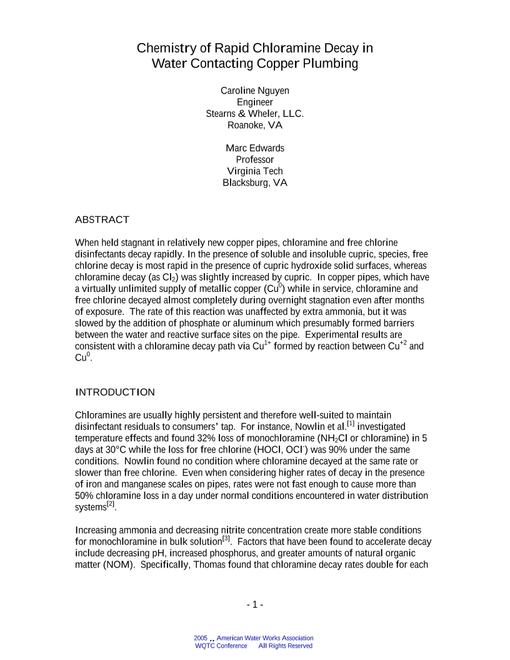
When held stagnant in relatively new copper pipes, chloramine and free chlorine
disinfectants decay rapidly. In the presence of soluble and insoluble cupric, species, free
chlorine decay is most rapid in the presence of cupric hydroxide solid surfaces, whereas
chloramine decay (as Cl2) was slightly increased by cupric. In copper pipes, which have
a virtually unlimited supply of metallic copper (Cu0) while in service, chloramine and
free chlorine decayed almost completely during overnight stagnation even after months
of exposure. The rate of this reaction was unaffected by extra ammonia, but it was
slowed by the addition of phosphate or aluminum which presumably formed barriers
between the water and reactive surface sites on the pipe. Experimental results are
consistent with a chloramine decay path via Cu1+ formed by reaction between Cu+2 and Cu0. Includes 16 references, table, figures.
| Edition : | Vol. - No. |
| File Size : | 1
file
, 750 KB |
| Note : | This product is unavailable in Ukraine, Russia, Belarus |
| Number of Pages : | 12 |
| Published : | 11/01/2005 |