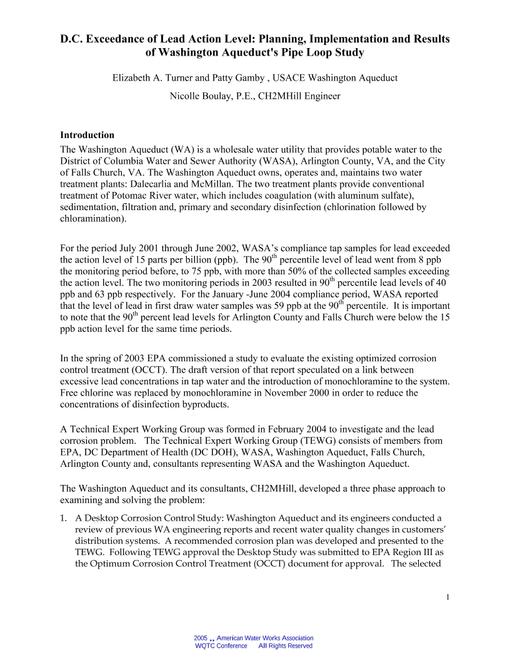
This paper discusses the planning, implementation and results of Washington Aqueduct's Pipe Loop Study that is designed to complement the ongoing lead research work being performed by the District of Columbia Water and Sewer Authority (WASA), the US Environmental Protection Agency (USEPA), and associated members of the Technical Expert Working Group. The primary purpose of the proposed flow-through, lead pipe loop testing is to evaluate the
effectiveness of alternate corrosion control strategies on reducing lead concentrations in District
of Columbia drinking water. Secondarily, the results obtained during the testing period will be
disseminated to the water industry at large as a good will offering. Based on the results and
recommendations of Washington Aqueduct's 2004 Desktop Evaluation, a comparison of the
effectiveness of two alternate corrosion inhibitors (phosphoric acid and zinc orthophosphate) will be
conducted. Filtered and finished water produced at Washington Aqueduct's Dalecarlia treatment plant is
used as source water for the testing. Additional treatment chemicals are added to the filtered
water flow stream to "simulate" finished water quality under a variety of conditions. Samples of lead service lines excavated from the Washington D.C. water distribution system
were used to construct the pipe loops to ensure that the test results replicate actual full-scale
conditions to the greatest degree possible. Includes 2 references.
| Edition : | Vol. - No. |
| File Size : | 1
file
, 200 KB |
| Note : | This product is unavailable in Ukraine, Russia, Belarus |
| Number of Pages : | 7 |
| Published : | 11/01/2005 |