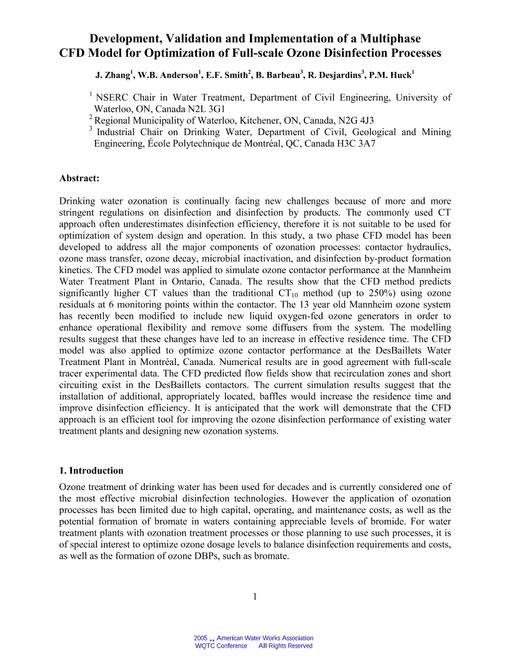
Drinking water ozonation is continually facing new challenges because of more and more
stringent regulations on disinfection and disinfection byproducts. The commonly used CT
approach often underestimates disinfection efficiency, therefore it is not suitable to be used for
optimization of system design and operation. In this study, a two phase CFD model has been
developed to address all the major components of ozonation processes: contactor hydraulics,
ozone mass transfer, ozone decay, microbial inactivation, and disinfection byproduct formation
kinetics. The CFD model was applied to simulate ozone contactor performance at the Mannheim
Water Treatment Plant in Ontario, Canada. The results show that the CFD method predicts
significantly higher CT values than the traditional CT10 method (up to 250%) using ozone
residuals at 6 monitoring points within the contactor. The 13 year old Mannheim ozone system
has recently been modified to include new liquid oxygen-fed ozone generators in order to
enhance operational flexibility and remove some diffusers from the system. The modelling
results suggest that these changes have led to an increase in effective residence time. The CFD
model was also applied to optimize ozone contactor performance at the DesBaillets Water
Treatment Plant in Montreal, Canada. Numerical results are in good agreement with full-scale
tracer experimental data. The CFD predicted flow fields show that recirculation zones and short
circuiting exist in the DesBaillets contactors. The current simulation results suggest that the
installation of additional, appropriately located, baffles would increase the residence time and
improve disinfection efficiency. It is anticipated that the work will demonstrate that the CFD
approach is an efficient tool for improving the ozone disinfection performance of existing water
treatment plants and designing new ozonation systems. Includes 15 references, figures.
| Edition : | Vol. - No. |
| File Size : | 1
file
, 930 KB |
| Note : | This product is unavailable in Ukraine, Russia, Belarus |
| Number of Pages : | 10 |
| Published : | 11/01/2005 |