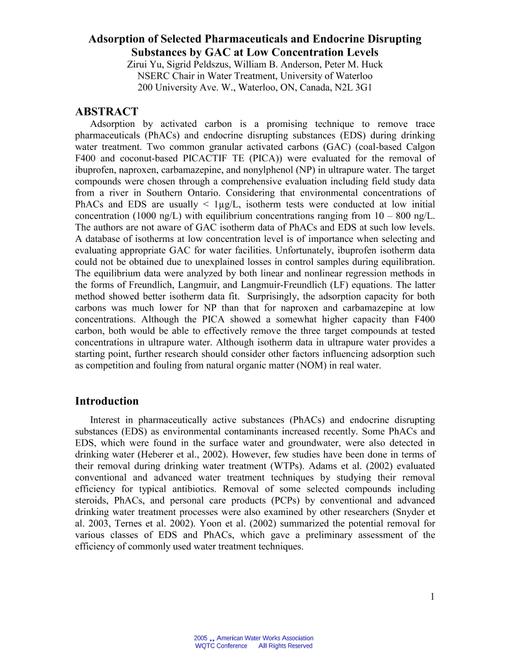
Adsorption by activated carbon is a promising technique to remove trace
pharmaceuticals (PhACs) and endocrine disrupting substances (EDS) during drinking
water treatment. Two common granular activated carbons (GAC) (coal-based Calgon
F400 and coconut-based PICACTIF TE (PICA)) were evaluated for the removal of
ibuprofen, naproxen, carbamazepine, and nonylphenol (NP) in ultrapure water. The target
compounds were chosen through a comprehensive evaluation including field study data
from a river in Southern Ontario. Considering that environmental concentrations of
PhACs and EDS are usually < 1µg/L, isotherm tests were conducted at low initial
concentration (1000 ng/L) with equilibrium concentrations ranging from 10 - 800 ng/L.
The authors are not aware of GAC isotherm data of PhACs and EDS at such low levels.
A database of isotherms at low concentration level is of importance when selecting and
evaluating appropriate GAC for water facilities. Unfortunately, ibuprofen isotherm data
could not be obtained due to unexplained losses in control samples during equilibration.
The equilibrium data were analyzed by both linear and nonlinear regression methods in
the forms of Freundlich, Langmuir, and Langmuir-Freundlich (LF) equations. The latter
method showed better isotherm data fit. Surprisingly, the adsorption capacity for both
carbons was much lower for NP than that for naproxen and carbamazepine at low
concentrations. Although the PICA showed a somewhat higher capacity than F400
carbon, both would be able to effectively remove the three target compounds at tested
concentrations in ultrapure water. Although isotherm data in ultrapure water provides a
starting point, further research should consider other factors influencing adsorption such
as competition and fouling from natural organic matter (NOM) in real water. Includes 19 references, tables, figures.
| Edition : | Vol. - No. |
| File Size : | 1
file
, 450 KB |
| Note : | This product is unavailable in Ukraine, Russia, Belarus |
| Number of Pages : | 16 |
| Published : | 11/01/2005 |