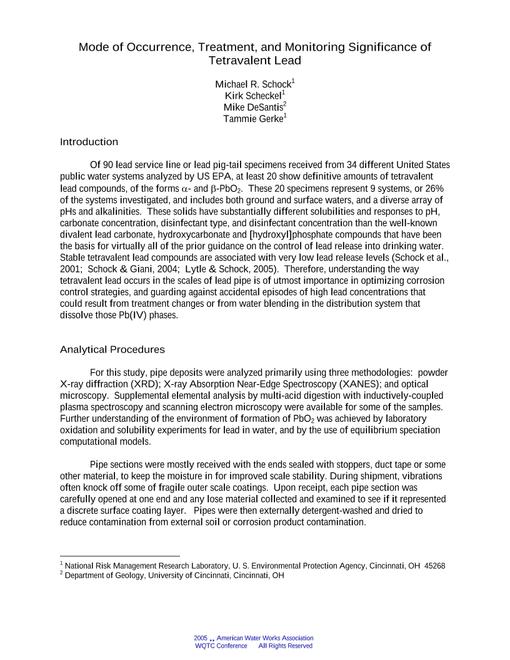
Of 90 lead service line or lead pig-tail specimens received from 34 different United States
public water systems analyzed by US Environmental Protection Agency (USEPA), at least 20 show definitive amounts of tetravalent
lead compounds, of the forms α- and ß-PbO2. These 20 specimens represent 9 systems, or 26%
of the systems investigated, and includes both ground and surface waters, and a diverse array of
pHs and alkalinities. These solids have substantially different solubilities and responses to pH,
carbonate concentration, disinfectant type, and disinfectant concentration than the well-known
divalent lead carbonate, hydroxycarbonate and [hydroxyl]phosphate compounds that have been
the basis for virtually all of the prior guidance on the control of lead release into drinking water.
Stable tetravalent lead compounds are associated with very low lead release levels (Schock et al.,
2001; Schock & Giani, 2004; Lytle & Schock, 2005). Therefore, understanding the way
tetravalent lead occurs in the scales of lead pipe is of utmost importance in optimizing corrosion
control strategies, and guarding against accidental episodes of high lead concentrations that
could result from treatment changes or from water blending in the distribution system that
dissolve those Pb(IV) phases.
For this study, pipe deposits were analyzed primarily using three methodologies: powder
X-ray diffraction (XRD); X-ray Absorption Near-Edge Spectroscopy (XANES); and optical
microscopy. Supplemental elemental analysis by multi-acid digestion with inductively-coupled
plasma spectroscopy and scanning electron microscopy were available for some of the samples.
Further understanding of the environment of formation of PbO2 was achieved by laboratory
oxidation and solubility experiments for lead in water, and by the use of equilibrium speciation
computational models. Includes 20 references, figures.
| Edition : | Vol. - No. |
| File Size : | 1
file
, 2.2 MB |
| Note : | This product is unavailable in Ukraine, Russia, Belarus |
| Number of Pages : | 15 |
| Published : | 11/01/2005 |