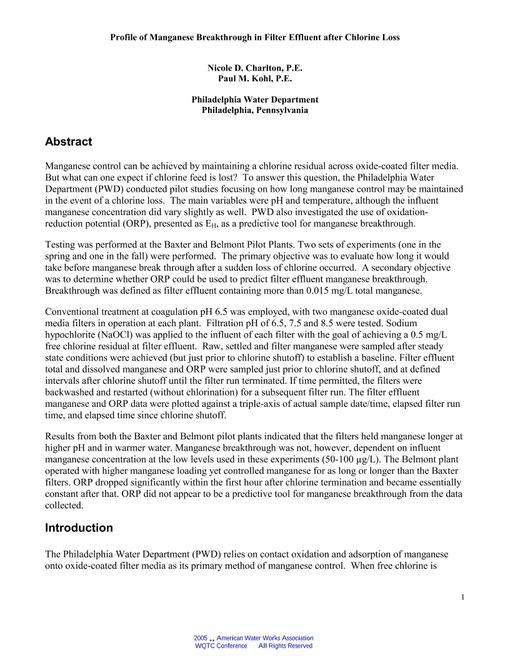
The Philadelphia Water
Department (PWD) conducted pilot studies focusing on how long manganese control may be maintained
in the event of a chlorine loss. The main variables were pH and temperature, although the influent
manganese concentration did vary slightly as well. PWD also investigated the use of oxidation-reduction
potential (ORP), presented as EH, as a predictive tool for manganese breakthrough.
Testing was performed at the Baxter and Belmont Pilot Plants. Two sets of experiments (one in the
spring and one in the fall) were performed. The primary objective was to evaluate how long it would
take before manganese breakthrough after a sudden loss of chlorine occurred. A secondary objective
was to determine whether ORP could be used to predict filter effluent manganese breakthrough.
Breakthrough was defined as filter effluent containing more than 0.015 mg/L total manganese.
Conventional treatment at coagulation pH 6.5 was employed, with two manganese oxide-coated dual
media filters in operation at each plant. Filtration pH of 6.5, 7.5 and 8.5 were tested. Sodium
hypochlorite (NaOCl) was applied to the influent of each filter with the goal of achieving a 0.5 mg/L
free chlorine residual at filter effluent. Raw, settled and filter manganese were sampled after steady
state conditions were achieved (but just prior to chlorine shutoff) to establish a baseline. Filter effluent
total and dissolved manganese and ORP were sampled just prior to chlorine shutoff, and at defined
intervals after chlorine shutoff until the filter run terminated. If time permitted, the filters were
backwashed and restarted (without chlorination) for a subsequent filter run. The filter effluent
manganese and ORP data were plotted against a triple-axis of actual sample date/time, elapsed filter run
time, and elapsed time since chlorine shutoff.
Results from both the Baxter and Belmont pilot plants indicated that the filters held manganese longer at
higher pH and in warmer water. Manganese breakthrough was not, however, dependent on influent
manganese concentration at the low levels used in these experiments (50-100 µg/L). The Belmont plant
operated with higher manganese loading yet controlled manganese for as long or longer than the Baxter
filters. ORP dropped significantly within the first hour after chlorine termination and became essentially
constant after that. ORP did not appear to be a predictive tool for manganese breakthrough from the data collected. Includes 3 references, tables, figures.
| Edition : | Vol. - No. |
| File Size : | 1
file
, 980 KB |
| Note : | This product is unavailable in Ukraine, Russia, Belarus |
| Number of Pages : | 23 |
| Published : | 11/01/2005 |