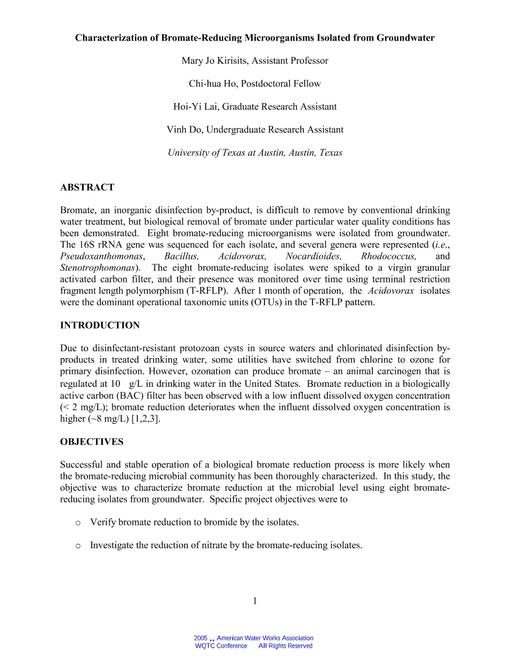
Successful and stable operation of a biological bromate reduction process is more likely when
the bromate-reducing microbial community has been thoroughly characterized. In this study, the
objective was to characterize bromate reduction at the microbial level using eight bromate-reducing
isolates from groundwater. Specific project objectives were to:
verify bromate reduction to bromide by the isolates;
investigate the reduction of nitrate by the bromate-reducing isolates;
sequence the 16S rDNA of the bromate-reducing isolates; and,
investigate bioaugmentation with the bromate-reducing isolates to shorten the start-up
time of a new BAC filtration process for bromate reduction.
Isolation of bromate-reducing microorganisms
M-R2A agar plates, containing essential nutrients, 100 g/L bromate, and 1 mM nitrate, were
prepared and degassed in an anaerobic chamber. The plates were inoculated with diluted
biomass from a 3-year-old BAC filter that had treated Champaign-Urbana tapwater
supplemented with 20 g/L bromate. The plates were incubated at room temperature in an argon
atmosphere. Various colonies were streaked to purity and tested for bromate reduction in
aqueous medium. Includes 5 references.
| Edition : | Vol. - No. |
| File Size : | 1
file
, 160 KB |
| Note : | This product is unavailable in Ukraine, Russia, Belarus |
| Number of Pages : | 4 |
| Published : | 11/01/2005 |