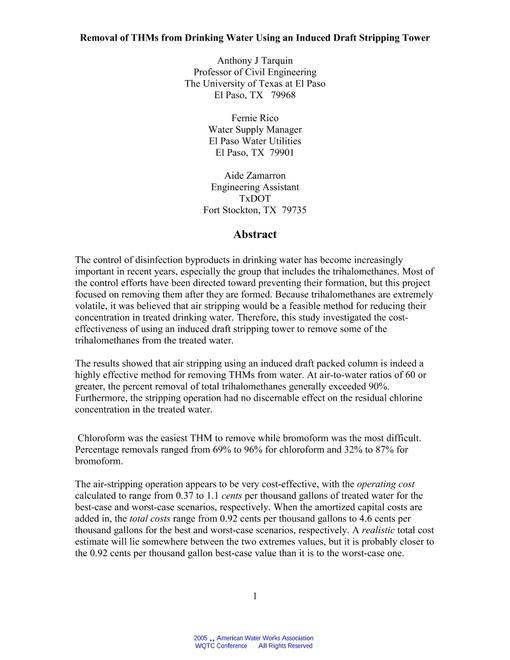
The control of disinfection byproducts in drinking water has become increasingly
important in recent years, especially the group that includes the trihalomethanes. Most of
the control efforts have been directed toward preventing their formation, but this project
focused on removing them after they are formed. Because trihalomethanes are extremely
volatile, it was believed that air stripping would be a feasible method for reducing their
concentration in treated drinking water. Therefore, this study investigated the cost-effectiveness
of using an induced draft stripping tower to remove some of the
trihalomethanes from the treated water.
The results showed that air stripping using an induced draft packed column is indeed a
highly effective method for removing THMs from water. At air-to-water ratios of 60 or
greater, the percent removal of total trihalomethanes generally exceeded 90%.
Furthermore, the stripping operation had no discernable effect on the residual chlorine
concentration in the treated water.
Chloroform was the easiest THM to remove while bromoform was the most difficult.
Percentage removals ranged from 69% to 96% for chloroform and 32% to 87% for
bromoform.
The air-stripping operation appears to be very cost-effective, with the operating cost
calculated to range from 0.37 to 1.1 cents per thousand gallons of treated water for the
best-case and worst-case scenarios, respectively. When the amortized capital costs are
added in, the total costs range from 0.92 cents per thousand gallons to 4.6 cents per
thousand gallons for the best and worst-case scenarios, respectively. A realistic total cost
estimate will lie somewhere between the two extremes values, but it is probably closer to
the 0.92 cents per thousand gallon best-case value than it is to the worst-case one. Includes 18 references, table, figures.
| Edition : | Vol. - No. |
| File Size : | 1
file
, 420 KB |
| Note : | This product is unavailable in Ukraine, Russia, Belarus |
| Number of Pages : | 19 |
| Published : | 11/01/2005 |