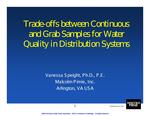
This powerpoint presentation begins by providing a brief overview of water quality sampling including continuous versus grab samples. The study objective was to examine sampling programs for two different case
study distribution systems to determine the tradeoffs
between continuous and grab samples. Study methodology included: using models for chlorine concentration, create
synthetic database to test different sampling
designs (simulated sampling to determine efficiency of each
sampling design); and, investigate the impact of storage volume on the
variability of chlorine and test hypothesis that larger storage volume is linked to
higher temporal variability in chlorine. Presentation conclusions indicate that: use of continuous monitors as a 1:1 substitute
for grab samples may not increase sampling
efficiency, even for systems with relatively high
temporal variability; continuous monitors are more helpful as a
supplement to grab samples but only when
locations are carefully selected; and, findings have implications for regulators
considering how to integrate continuous
monitors into compliance sampling programs. Includes tables, figures.
| Edition : | Vol. - No. |
| File Size : | 1
file
, 1.2 MB |
| Note : | This product is unavailable in Ukraine, Russia, Belarus |
| Number of Pages : | 18 |
| Published : | 11/01/2009 |