Name:
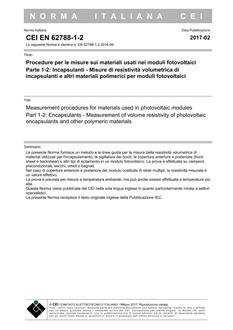
CEI EN 62788-1-2 PDF
Published Date:
02/01/2017
Status:
[ Active ]
Publisher:
Comitato Elettrotecnico Italiano
This part of IEC 62788 provides a method and guidelines for measuring the volume resistivity of materials used as encapsulation, edge seals, front-sheets, backsheets, or any other insulating material in a photovoltaic (PV) module. The test is performed on dry, humid or wet preconditioned samples. In the case of frontsheets and backsheets comprised of multiple layers, the measured resistivity is an effective value. This test is designed for room temperature measurement, but can also be utilized at higher temperatures.
Degradation of PV modules is known to occur in part by electrochemical corrosion, and other potential induced degradation processes. These processes may be dependent upon the resistivity of a polymeric component. Therefore, the DC resistivity of polymeric components is relevant to module design and durability in the field. The resistivity may depend on cure state, temperature, water content, and voltage history. A number of options are included to allow the measurement to be performed in a manner consistent with representative fielded module conditions.
Most resistivity measurement methods and equipment typically become inaccurate and variable for materials with volume resistivity above 1016 Ω∙cm [5]1.Therefore, this standard is used for measurements less than 1⋅1017 Ω∙cm.
Both monolithic and multilayer materials (e.g. frontsheets and backsheets) are suitable for measurement. Methods are described for room temperature measurement, with guidelines included for testing at elevated temperatures.
Results will vary with moisture content, therefore materials should be tested in a manner anticipatory of usage. Preconditioning procedures for dry, humid and wet environments are included.
Depending on the material, voltage history will affect the measured result. The rate of change of current, and time to equilibrium varies with material often taking hours or days to come to a static level. For this reason, long and short duration methods are included (Methods A and B). The specified short-duration alternating polarity Method B is intended for qualitative comparison. Method A, long-duration on/off polarity, is recommended for characterization with regard to PID resistance.
Measurements obtained using either method may be used by material manufacturers for the purpose of quality control of their electrical insulating material as well as for reporting in product datasheets. PV module manufacturers may use these methods for the purpose of material acceptance, material selection, process development, design analysis, or failure analysis.
This measurement method can also be utilized to monitor the performance of electrical insulating materials after weathering, to assess their durability.
1 Numbers in square brackets refer to the Bibliography.
| Edition : | 17 |
| File Size : | 1 file , 510 KB |
| Number of Pages : | 24 |
| Published : | 02/01/2017 |