Name:
CEI EN IEC 60904-9 PDF
Published Date:
06/01/2021
Status:
[ Active ]
Publisher:
Comitato Elettrotecnico Italiano
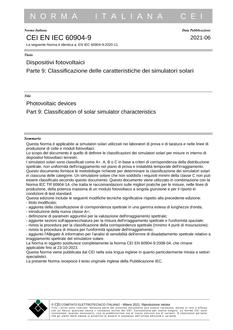
IEC standards for photovoltaic devices require the use of specific classes of solar simulators deemed appropriate for specific tests. Solar simulators can be either used for performance measurements of PV devices or endurance irradiation tests. This part of IEC 60904 provides the definitions of and means for determining simulator classifications at the required irradiance levels used for electrical stabilization and characterisation of PV devices.
This document is applicable for solar simulators used in PV test and calibration laboratories and in manufacturing lines of solar cells and PV modules. The A+ category is primarily intended for calibration laboratories and is not considered necessary for power measurements in PV manufacturing and in qualification testing. Class A+ has been introduced because it allows for reduction in the uncertainty of secondary reference device calibration, which is usually performed in a calibration laboratory. Measurement uncertainty in PV production lines will directly benefit from a lower uncertainty of calibration, because production line measurements are performed using secondary reference devices.
In the case of PV performance measurements, using a solar simulator of a particular class does not eliminate the need to quantify the influence of the simulator on the measurement by making spectral mismatch corrections and analysing the influences of spatial non-uniformity of irradiance in the test plane and temporal stability of irradiance on that measurement. Test reports for PV devices tested with the simulator report the class of simulator used for the measurement and the method used to quantify the simulator’s effect on the results.
The purpose of this document is to define classifications of solar simulators for use in indoor measurements of terrestrial photovoltaic devices. Solar simulators are classified as A+, A, B or C based on criteria of spectral distribution match, irradiance non-uniformity in the test plane and temporal instability of irradiance. This document provides the required methodologies for determining the classification of solar simulators in each of the categories. A solar simulator which does not meet the minimum requirements of class C cannot be classified according to this document.
For spectral match classification a new procedure has been added. This procedure addresses the actual need for an extended wavelength range, which is arising from advances in solar cell technology (such as increased spectral responsivity below 400 nm) as well as solar simulator technology (use of component LEDs). The procedure of the second edition of this standard is still valid, but is only applied if backward compatibility of classification for solar simulators already in use and for solar simulators in production/sale is required. This document is referred to by other IEC standards, in which class requirements are laid down for the use of solar simulators. The solar simulator characteristics described in this document are not used in isolation to imply any level of measurement confidence or measurement uncertainty for a solar simulator application (for example, PV module power measurement). Measurement uncertainties in each application depend on many factors, several of which are outside the scope of this document:
• Characteristics of the solar simulator, possibly including characteristics not covered by this document;
• Methods used to calibrate and operate the solar simulator;
• Characteristics of the device(s) under test (for example, size and spectral responsivity);
• Quantities measured from the device(s) under test, including equipment and methods used for measurement;
• Possible corrections applied to measured quantities.
When applications require a certain solar simulator characteristic, it is preferable to specify a numerical value rather than a letter classification (for example, “≤ 5 % non-uniformity of irradiance” rather than “Class B non-uniformity of irradiance”). If not obvious from the application, it should also be indicated how the required simulator characteristic correlates to relevant measured quantities. Since PV module power measurement is one of the most common applications for solar simulators, brief guidance on this application is given in informative notes for each solar simulator characteristic described in this document. This document is used in combination with IEC TR 60904-14, which deals with best practice recommendations for production line measurements of single-junction PV module maximum power output and reporting at standard test conditions. For output power characterization of PV devices, IEC TR 60904-14 addresses the relevance of the letter grades (A+, A, B, C) for measurement uncertainty.
| Edition : | 21 |
| File Size : | 1 file , 2.6 MB |
| Number of Pages : | 38 |
| Published : | 06/01/2021 |