Name:
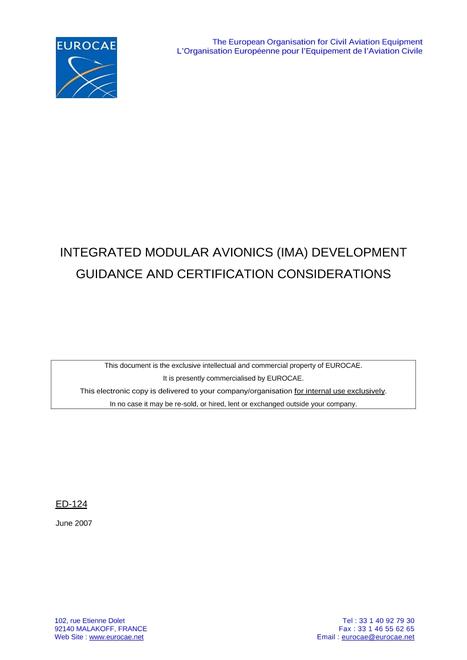
EUROCAE ED-124 PDF
Published Date:
06/01/2007
Status:
[ Active ]
Publisher:
European Organization for Civil Aviation Equipment
This document is applicable to all parties involved in the development, integration, verification, and validation of IMA systems. The guidance in this document is focused on IMA-specific aspects of design assurance. As such it relies on other recognized documents that provide additional guidance on overall aircraft certification, system development, software assurance, and hardware assurance.
As defined in this document, IMA is described as a shared set of flexible, reusable, and interoperable hardware and software resources that, when integrated, form a platform that provides services, designed and verified to a defined set of requirements, to host applications performing aircraft functions. Key IMA and certification terms are described in Section 2.2 and in the glossary.
The primary industry-accepted guidance for satisfying airworthiness requirements for IMA components is included in Section 1.5. The ability to obtain incremental acceptance of individual items of the IMA platform (including the core software) and hosted applications enables the reduction of follow-on certification efforts without compromising system safety.
This document describes application properties as they relate to their integration with a platform; however, it does not address the specific functionality of applications nor specific Technical Standard Order (TSO)/European Technical Standard Order (ETSO) requirements, Minimum Operational Performance Specifications (MOPS), or Minimum Aviation System Performance Specifications (MASPS).
PURPOSE
This document contains guidance for Integrated Modular Avionics (IMA) developers, application developers, integrators, certification applicants, and those involved in the approval and continued airworthiness of IMA systems in civil certification projects. The guidance describes the objectives, processes, and activities for those involved in the development and integration of IMA modules, applications, and systems to incrementally accumulate design assurance toward the installation and approval of an IMA system on an approved aviation product as differentiated from traditional federated aviation system architectures.
IMA system concepts are presented, including the platform and modules, and their relationships to the hosted applications and avionics functions used in an aircraft installation. This includes the description of how the developers and integrators can accumulate incremental acceptance of the modules, platform, and application integration which will provide a means for applicants to achieve design assurance of an IMA system on an approved aviation product.
During the IMA system development the certification applicant for a Type Certificate (TC) or Supplemental Type Certificate (STC) program should develop an effective system of communication among the module and platform developers and system integrators. This is especially important when these suppliers are from different companies. Otherwise, there may be a misunderstanding of the implementation during final integration and approval of the IMA system installation.
Six tasks define the incremental acceptance of IMA systems in the certification process:
• Task 1: Module acceptance.
• Task 2: Application software or hardware acceptance.
• Task 3: IMA system acceptance.
• Task 4: Aircraft integration of IMA system - including Validation and Verification (V&V).
• Task 5: Change of modules or applications.
• Task 6: Reuse of modules or applications.
Approval of an IMA system installation may be based on the accumulation of incremental acceptance, culminating in the complete design assurance needed to demonstrate that the installed system and functions comply with the applicable regulations and guidance.
The incremental acceptance, if appropriate, may be granted in the form of an acceptance letter, stamped type design data, or other means for the specific project.
| Edition : | 07 |
| File Size : | 1 file , 690 KB |
| Number of Pages : | 118 |
| Published : | 06/01/2007 |