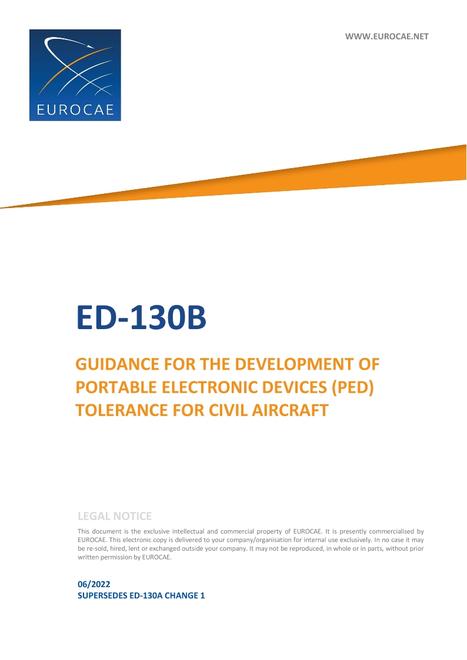
Name:
EUROCAE ED-130B PDF
Published Date:
06/01/2022
Status:
[ Active ]
Publisher:
European Organization for Civil Aviation Equipment
This report provides specific recommendations for operators as well as certification applicants performing aircraft Type Certificate (TC), Supplemental Type Certificate (STC) and Amended Type Certificate (ATC) to show how aircraft avionics and electrical system can be tolerant to the use of portable electronic devices (PEDs) throughout various phases of flight. The aircraft design guidance meeting regulatory requirements address any kind of PEDs, including transmitting PEDs Although throughout this document the word Applicant is used, the guidance in this document is applicable to STC/TC/ATC applicants and Operators. It is acknowledged that per the regulation in TABLE 3-1 & TABLE 3-2 that no CFR 14 Part 23/25/27/29 and EU Regulation 965/2012 regulatory approval is required for in-flight use of PEDs.
The report recommends specific RF immunity requirements for aircraft systems that are exposed to PED intentional RF transmissions (back door coupling) and specific Interference Path Loss requirement for those radio systems that can be vulnerable to PED spurious emissions through antennas (front door coupling). The front door coupling is essentially unchanged from previous guidance produced in DO-307, with additional guidance provide for similarity. Additional guidance is provided related to meeting regulatory requirements is discussed in section 3 that needs to be considered when complying with aircraft PED tolerance. For aircraft that successfully meet the requirements in chapters 5, 6 and 7 of this report, aircraft operators will have high assurance that the aircraft electrical and avionics systems will have and maintain aircraft PED tolerance even in critical phases of flight.
This guidance, nor current FAA/EASA policy, recommend mandatory requirements for aircraft PED interference tolerance. It does provide standard methods to demonstrate aircraft PED tolerance. It is highly recommended that PED tolerance is demonstrated for aircraft that are intended to be operated as air carriers (e.g. FAA Part 121).
When the recommendation of this document is followed, it provides control of interference to avionics and electrical system from the operation of PEDs. The EMC tolerance aspect for a new wireless system installation that enables transmitting PEDs should be certified on an aircraft under a TC/STC/ATC. Methods from aircraft level testing from section 6 can supplement EMC demonstration for the installed wireless service.
When demonstrating aircraft PED tolerance, the following items are considered to be out of scope for this document:
1. Operational aspects of PED use that are related to crew procedures and stowageGuidance for this can be found in, FAA InFO 13010 and InFO 13010SUP, EASAAnnex to Decision 2014/029/R, Part-CAT AMC/GM Issue 2, Amendment 1 andICAO Circular 340 AN/198 for example.
2. Interference to terrestrial communication networks and spectrum licensing is notaddressed. Similarly, health concerns are not a subject of this document.
3. Country-specific telecommunication regulations that disallow the use of PEDs onaircraft (e.g. the case of FCC with cell phones).
4. Country- or region-specific telecommunication regulation and certificationrequirements for Short Range Devices (SRDs) in terms of used frequencies,radiated power and operational modes.
| Edition : | B |
| File Size : | 1 file , 11 MB |
| Number of Pages : | 189 |
| Published : | 06/01/2022 |