Name:
GMW GMW14400 PDF
Published Date:
05/01/2012
Status:
[ Revised ]
Publisher:
General Motors Worldwide
This specification covers the requirements for low carbon, heat-treatable boron steel used in the manufacture of structural parts to manage very high tensile loads without significant deformation such as required in safety and occupant protection. This material is heat treated and then formed and simultaneously quenched in a water-cooled die in a process referred to as hot stamping, hot press forming or press hardening. Material produced by this process generally referred to as press hardened steel (PHS). This process results in a part with a microstructure consisting of essentially 100% tempered martensite or martensite with trace amounts of bainite.
Note: For bonded applications with pre-coated press hardened steel, the material shall meet additional coating adhesion requirements in 3.2.7 and adhesive compatibility requirements in 3.3.2.
Material Description. The material designation is defined by the GMW material specification number, material category (Sheet or Tubular product), steel product type, grade, and finish type. The substrates used in these applications may be cold rolled or hot rolled, but the product type is designated as heat treated (HT) or hot stamped (HS), as appropriate. The steel grades will correspond to the chemical and mechanical requirements as shown in Table 2 and Table A1 through Table A3. The surface quality, represented as an alpha character, shall be designated with the surface quality. Only the surface quality designation of U, representing an unexposed application, shall be used unless otherwise approved by Materials Engineering. The above descriptive items are used together to form the coding system. Examples of the coding system for engineering part drawings, electronic math data files and/or manufacturing engineering documents are shown in Section 8.
Resistance Welded Mechanical Tubing. Tubes supplied to this specification are roll formed from a steel strip to the desired shape and dimension, electrical resistance welded into a tube, and then heat treated to achieve the final mechanical property requirements.
Induction Heat Treated Steel. Part sections formed with this operation and supplied under this standard shall be made by stamping in the as-rolled condition. The raw stamping can be selectively coil induction hardened to achieve the required strength requirements. Al-Si, Zn, Zn-Fe, or Zn-Ni pre-coated products shall not be used in these applications.
Hot Stamped Die Quenched Steel. Parts shall be made by austenitizing a pre-cut blank, hot stamping the heated blank and rapid cooling (quenching) the stamped part in the die or via water quenching. Press hardened steel (PHS) can be formed by either direct or indirect stamping processes. The direct process is considered as main-stream for all usages (except tubes). The indirect process is less common and more expensive since it requires two dies and is not compatible with common oven designs and press systems.
Note: Since the indirect stamping process is not globally available, the indirect process must not be used (or parts designed to require its use) without the prior authorization of the Global Functional Lead (GFL). Use of the indirect process implies that effected part cannot be used globally without driving excessive cost to ship stamped parts globally. Exception: The indirect process is globally available and can be used without prior approval only for tubular products such as axle tubes.
Uncoated Products. Parts formed with uncoated steel and supplied under this standard shall be subsequently blasted to remove oxide from the surface as described in section 3.3.3.2.
Pre-Coated Products. Parts formed with a hot stamping operation may also utilize pre-coated steels furnished according to this specification in order to eliminate the need for blasting and/or improve corrosion performance.
• Aluminum-Silicon (Al-Si) Pre-Coatings: Al-Si coated parts shall not be cold-stamped prior to the hot stamping operation, but slight roll-forming operations may be allowable if the coating is not damaged. Blasting is not permitted for Al-Si pre-coated parts to prevent damage of the coating.
• Zinc Based Pre-Coatings: Parts are preferably stamped by the direct hot stamping process. After hot forming and cooling, parts shall be blasted to remove any oxide layer from the surface as described in section 3.3.3.2.
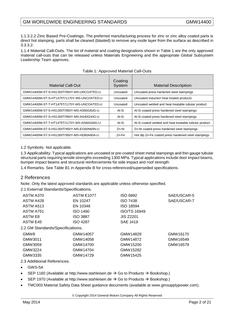
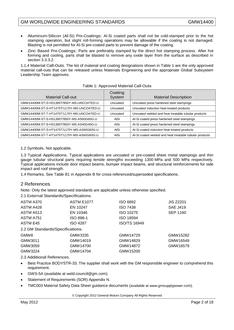
Material Call-Outs. The list of material and coating designations shown in Table 1 are the only approved material call-outs that can be released unless Materials Engineering and the appropriate Global Subsystem Leadership Team approves.
Typical Applications. Typical applications are uncoated or pre-coated sheet metal stampings and thin gauge tubular structural parts requiring tensile strengths exceeding 1300 MPa and 500 MPa respectively. Typical applications include door impact beams, bumper impact beams, and structural reinforcements for side impact and roof strength.
| Edition : | 8 |
| File Size : | 1 file , 510 KB |
| Number of Pages : | 18 |
| Published : | 05/01/2012 |