Name:
GMW GMW18293 PDF
Published Date:
09/01/2021
Status:
[ Revised ]
Publisher:
General Motors Worldwide
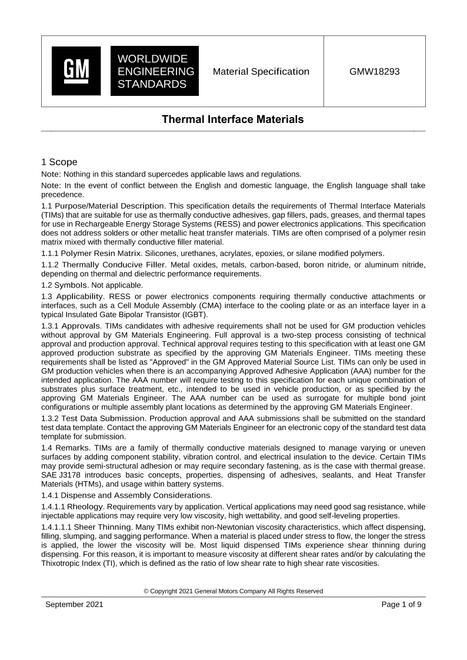
Note: Nothing in this standard supercedes applicable laws and regulations.
Note: In the event of conflict between the English and domestic language, the English language shall take precedence.
Purpose/Material Description.
This specification details the requirements of Thermal Interface Materials (TIMs) that are suitable for use as thermally conductive adhesives, gap fillers, pads, greases, and thermal tapes for use in Rechargeable Energy Storage Systems (RESS) and power electronics applications. This specification does not address solders or other metallic heat transfer materials. TIMs are often comprised of a polymer resin matrix mixed with thermally conductive filler material.
Polymer Resin Matrix.
Silicones, urethanes, acrylates, epoxies, or silane modified polymers.
Thermally Conducive Filler.
Metal oxides, metals, carbon-based, boron nitride, or aluminum nitride, depending on thermal and dielectric performance requirements.
Symbols.
Not applicable.
Applicability.
RESS or power electronics components requiring thermally conductive attachments or interfaces, such as a Cell Module Assembly (CMA) interface to the cooling plate or as an interface layer in a typical Insulated Gate Bipolar Transistor (IGBT).
Approvals.
TIMs candidates with adhesive requirements shall not be used for GM production vehicles without approval by GM Materials Engineering. Full approval is a two-step process consisting of technical approval and production approval. Technical approval requires testing to this specification with at least one GM approved production substrate as specified by the approving GM Materials Engineer. TIMs meeting these requirements shall be listed as "Approved" in the GM Approved Material Source List. TIMs can only be used in GM production vehicles when there is an accompanying Approved Adhesive Application (AAA) number for the intended application. The AAA number will require testing to this specification for each unique combination of substrates plus surface treatment, etc., intended to be used in vehicle production, or as specified by the approving GM Materials Engineer. The AAA number can be used as surrogate for multiple bond joint configurations or multiple assembly plant locations as determined by the approving GM Materials Engineer.
Test Data Submission.
Production approval and AAA submissions shall be submitted on the standard test data template. Contact the approving GM Materials Engineer for an electronic copy of the standard test data template for submission.
Remarks.
TIMs are a family of thermally conductive materials designed to manage varying or uneven surfaces by adding component stability, vibration control, and electrical insulation to the device. Certain TIMs may provide semi-structural adhesion or may require secondary fastening, as is the case with thermal grease. SAE J3178 introduces basic concepts, properties, dispensing of adhesives, sealants, and Heat Transfer Materials (HTMs), and usage within battery systems.
Dispense and Assembly Considerations.
Rheology.
Requirements vary by application. Vertical applications may need good sag resistance, while injectable applications may require very low viscosity, high wettability, and good self-leveling properties.
Sheer Thinning.
Many TIMs exhibit non-Newtonian viscosity characteristics, which affect dispensing, filling, slumping, and sagging performance. When a material is placed under stress to flow, the longer the stress is applied, the lower the viscosity will be. Most liquid dispensed TIMs experience shear thinning during dispensing. For this reason, it is important to measure viscosity at different shear rates and/or by calculating the Thixotropic Index (TI), which is defined as the ratio of low shear rate to high shear rate viscosities.
Flow Rate.
A good indicator of a liquid TIMs dispensability when viscosity data is not readily available. Flow rate testing assumes that temperature and shear stress, i.e., dispense pressure, remain constant during the test.
Heat.
Heating of TIMs during dispense may be used to temporarily reduce the viscosity, though working time is typically reduced.
Wet Out.
The ʺfootprintʺ of TIMs surface area on each side of an interface that the TIMs covers.]
Bond-Line-Thickness (BLT).
The TIMs thickness, or height, kept to a minimum for best performance. BLT is inversely proportional to thermal conductance.
Component Retention for Cure.
Assemblies requiring cure require a mechanical means of component retention, i.e., hems, fasteners, welds, and/or fixtures until the TIMS has attained sufficient strength for handling.
Coated Substrates.
Structural TIMs applications involving a substrate with a coating, shall demonstrate that the bond strength of the coating to the substrate is greater than the bond strength of the TIMs to the coating following all test conditions required by this specification. Coatings include e-coat or other paint coatings, laminations, isolation films, plating, Plasma Vapor Deposition Coatings (PVD), etc.
| Edition : | 2 |
| File Size : | 1 file , 250 KB |
| Number of Pages : | 9 |
| Published : | 09/01/2021 |