IETF RFC 7442 PDF

IETF RFC 7442 PDF

Name:
IETF RFC 7442 PDF

Published Date:
02/01/2015

Status:
[ Active ]

Description:

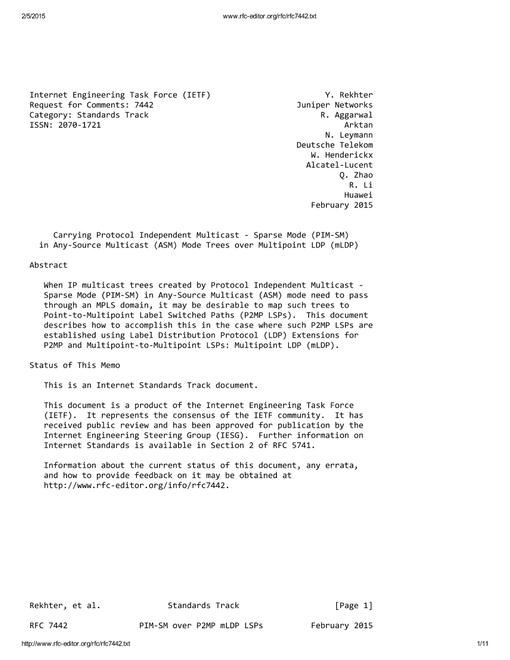
Carrying Protocol Independent Multicast ‐ Sparse Mode (PIM‐SM) in Any‐Source Multicast (ASM) Mode Trees over Multipoint LDP (mLDP)

Publisher:
Internet Engineering Task Force

Document status:
Active

Format:
Electronic (PDF)

Delivery time:
10 minutes

Delivery time (for Czech version):
200 business days

SKU:
ietf-rfc-7442_2812542

Choose Document Language:
9.90 €
Need Help?

When IP multicast trees created by Protocol Independent Multicast ‐ Sparse Mode (PIM‐SM) in Any‐Source Multicast (ASM) mode need to pass through an MPLS domain, it may be desirable to map such trees to Point‐to‐Multipoint Label Switched Paths (P2MP LSPs). This document describes how to accomplish this in the case where such P2MP LSPs are established using Label Distribution Protocol (LDP) Extensions for P2MP and Multipoint‐to‐Multipoint LSPs: Multipoint LDP (mLDP).


Edition : 15
File Size : 1 file , 160 KB
Number of Pages : 11
Published : 02/01/2015

History


Related products

IETF RFC 9010
Published Date: 04/01/2021
Routing for RPL (Routing Protocol for Low-Power and Lossy Networks) Leaves
13.20 €

Best-Selling Products

NS-ISO 1000:1992
Published Date: 12/18/1996
SI units and recommendations for the use of their multiples and of certain other units
NS-ISO 10001:2007
Published Date: 05/01/2014
Quality management — Customer satisfaction — Guidelines for codes of conduct for organizations
NS-ISO 10001:2018
Published Date: 02/01/2019
Quality management — Customer satisfaction — Guidelines for codes of conduct for organizations
NS-ISO 10002:2004
Published Date: 08/10/2004
Quality management - Customer satisfaction - Guidelines for complaints handling in organizations
NS-ISO 10002:2014
Published Date: 07/01/2015
Quality management — Customer satisfaction — Guidelines for complaints handling in organizations
NS-ISO 10002:2018
Published Date: 02/01/2019
Quality management — Customer satisfaction — Guidelines for complaints handling in organizations
