Name:
NG UKBP/TP 106A PDF
Published Date:
06/01/2009
Status:
[ Revised ]
Publisher:
National Grid
PURPOSE AND SCOPE
Application
a) This procedure defines National Grid requirements for the commissioning, decommissioning and recommissioning of all Equipment covered by the Electricity Transmission Licence including both overhead lines and cables, and auxiliaryequipment. It also defines the commissioning / decommissioning / recommissioning requirements of unlicensedEquipment when undertaken by National Grid. Appendix R provides an overview of the licensed process.
b) The procedure is formatted on the basis that theEquipment to be commissioned / decommissioned / recommissioned forms part of a capital investment delivered by an Alliance. The procedure therefore defines both the National Grid, and Alliance side, tasks and responsibilities. When commissioning / decommissioning / recommissioning takes place under other circumstances (eg. following equipment fault and replacement), then the responsible managers must adhere to the principles of this document.
c) TP106A defines a framework of requirements which will apply to the majority of investments. Where it is evident that TP106A does not provide a fully satisfactory framework (eg. a purely civil engineering project) then formally defined alternative arrangements specified by the Commissioning Panel (which may include alternative commissioning authorisation arrangements) may be defined and utilised. Such arrangements must utilise the principles defined in this document.
d) Where there is more than one project being carried out at a single substation the following criteria shall be used to determine whether separate or combined Commissioning Panel(s) shall be held.
1. If the projects are completely separate and there are no commissioning interfaces, separate Commissioning Panels should be held, a combined TP153 Coordination meeting should be held.
2. If the projects overlap, i.e. use of circuits/schemes one Commissioning Panel held with one being nominated as the lead project and providing the Chairman. The project manager/engineer of the other projects (not the lead) will retain responsibility for those aspect usually covered by the Chairman (i.e. signing part 1 of CCCC and the Commissioning Report for his own project). Each project will have its own appointed Commissioning Officer, each one shall attend the Commissioning Panel (in some instances these may be one of the same individual). A combined TP153A meeting to be held.
3. In the unlikely event that there is more than one project, but the design for both projects is carried out by one party, a single Commissioning Panel with a single Chairman and Commissioning Officer shall be held, with both the Chairman and Commissioning Officer having full responsibility for both projects. A combined TP153A meeting to be held.
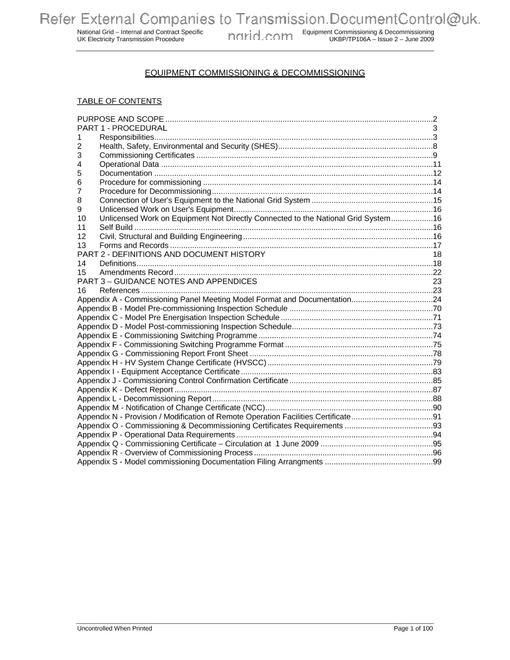
e) Appendix A (Commissioning Panel Meeting Model Format) forms the executive part of this procedure. This appendix is the cornerstone of TP106A and links to all other requirements defined in the document.
f) For simple or repetitive projects the Commissioning Panel may define an abridged version of Appendix A.
NB: In this procedure the term commissioning will usually be taken to include the requirements of commissioning, decommissioning and recommissioning.
| Edition : | 2 |
| File Size : | 1 file , 1 MB |
| Number of Pages : | 100 |
| Published : | 06/01/2009 |