Name:
BO-2374(RP 79) -- Pressure Drop in Flat-Oval Spiral Air Duct PDF
Published Date:
1975
Status:
Active
Publisher:
ASHRAE
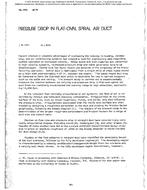
Recent interest in possible advantages of increasing the velocity in heating, ventilating, and air conditioning systems has created a need for engineering data regarding system operation at increased velocity. While space and duct material are conserved in high velocity systems, increased pressure drop and noise generation tend to be disadvantages. Spiral duct has found recent use because of the simplicity of the manufacturing operation. Spiral duct is fabricated from a single strip of sheet metal wound as a helix with approximately 4.67 in. between the seams. This basic round duct may be flattened to form the flat-oval duct which is desirable for use in narrow locations such as the walls and ceiling. The present study is carried out to experimentally measure the relation between air velocity and pressure drop in flat-oval spiral air. duct from the commonly encountered low velocity range to high velocities, approaching 14,000 fpm.
In the turbulent flow normally encountered in air systems, the flow of air is restricted by viscous and turbulent viscosity components. Irregularities on the inside surface of the duct, such as metal roughness, rivets, and joints, will also influence the pressure drop. Irregularities associated with the inside duct surface are often treated by assigning a roughness parameter to the duct and plotting the friction factor graphically, following the Moody diagram (1). The subject of the present study is the determination of the proper roughness parameters and friction factors for a range of duct size and aspect ratio.
Studies on flow rate and pressure drop in straight duct have covered many commonly encountered shapes, including round (2), rectan~ular (3), and other shapes (4). Results of these studies have led to the current ASHRAE-recommended design practice in which an absolute roughness of .0005 on the Moody diagram is recommended for duct design (2, 5).
| File Size : | 1 file , 1.2 MB |
| Note : | This product is unavailable in Russia, Belarus |
| Number of Pages : | 12 |
| Product Code(s) : | D-BO-2374 |
| Published : | 1975 |