Name:
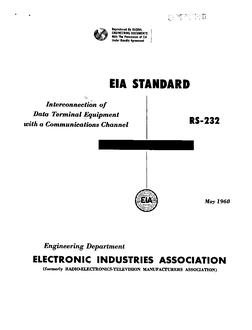
TIA RS-232 PDF
Published Date:
05/01/1960
Status:
[ Revised ]
Publisher:
Telecommunications Industry Association
PURPOSE AND SCOPE OF COVERAGE
This standard is intended to provide a method of interconnecting data terminal equipment and a data communication channel when each is furnished by different companies. It defines a means of exchanging control signals and binary serialized data signals between data terminal equipment and a data communication channel in cases where interchange point.
The data communication channel includes transmitting and receiving signal converters to permit the data communication channel to exchange standardized signals with the data terminal equipment. These standardized signals are defined in section 4.
The data re to be serialized by the data terminal equipment, so that the design of the data communication channel may be independent of the character length and code used by the data terminal equipment.
It is intended that the signal interchange shall be located on the customer's premises and that the interchange circuits shall convey signals over relatively short distances (i.e., less than fifty feet).
Performance standards herein are not specified for the data communication channel or its associated equipment, either for maximum distortion of the received signals, transmission error rates, or interruptions or normal service. If the performance requirements of the complete system are more stringent than the expected performance of the data communication channel, the data terminal equipment may include error checking arrangements.
This standard neither requires nor prohibits pulse regeneration equipment associated with the data communication channel.
This standard is intended for modulation rates above 100 bauds.
The control circuits are the signal interchange are arranged to permit the alternate use of a higher class of communication service,. As follows:
(a) Data Terminal equipment designed for send-only service may also use either Half-Duplex or Full-Duplex service.
(b) Data Terminal equipment designed for Receive-only service may also use either half-duplex or full-duplex.
(c) Data Terminal equipment designed for half-Duplex service may also use Full-Duplex service.
The substitution of a higher class of communication services does not require a change in the operation of the control circuits.
| Edition : | 60 |
| File Size : | 1 file , 290 KB |
| Number of Pages : | 8 |
| Published : | 05/01/1960 |