Name:
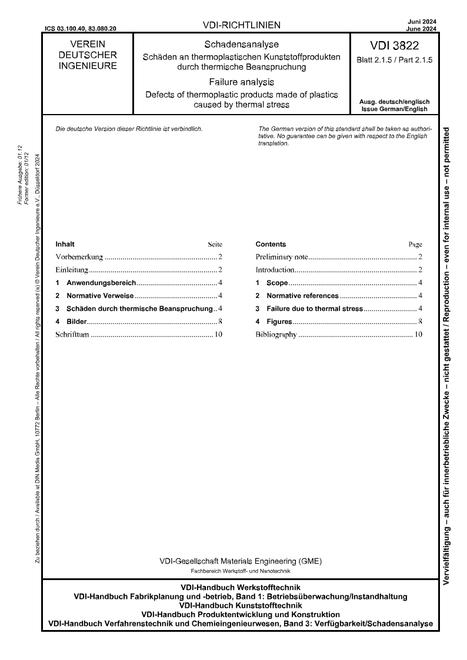
VDI VDI 3822 BLATT 2.1.5 PDF
Published Date:
01/01/2013
Status:
[ Revised ]
Publisher:
Verband Deutscher Ingenieure / Association of German Engineers
In this guideline, the following types of stress will be addressed:
The effects of temperature stress on thermoplastics, resulting both from the influence of temperature alone and of temperature in combination with exposure to air, will be addressed.
At the same time, it is also true that temperature not only directly contributes to failure, temperature also accelerates all chemical reactions (Arrhenius's Law). This also applies in the case of chemical stress (VDI 3822 Part 2.1.7) and weather induced stress (VDI 3822 Part 2.1.8).
The effects of mechanical, tribology-induced and biological stress on thermoplastics are also highly dependent on temperature. In relation to mechanical (VDI 3822 Part 2.1.4) and tribological (VDI 3822 Part 2.1.6) properties, it is often of decisive importance whether a semicrystalline plastic is in an energy or entropy elastic range (above/below the glass transition temperature) and, hence, some properties can change dramatically in the wake of glass transition. Below the glass transition temperature (energy elastic range) semicrystalline thermoplastics exhibit brittle behaviour and exibit ductile behaviour above it (entropy elastic range). Similar behaviour is also exhibited by amorphous thermoplastics, whereby the ductility increases evenly with increasing temperature.
Biological properties (VDI 3822 Part 2.1.9) are influenced by temperature to the extent that temperature is a factor in creating the appropriate environment for micro-organisms.
| Edition : | 13 |
| File Size : | 1 file , 13 MB |
| Number of Pages : | 11 |
| Product Code(s) : | 08 VDI, 08 VDI |
| Published : | 01/01/2013 |