ASTM E761/E761M-92(2020) PDF

ASTM E761/E761M-92(2020) PDF

Name:
ASTM E761/E761M-92(2020) PDF

Published Date:
04/01/2020

Status:
Active

Description:

Standard Test Method for Compressive Strength of Sprayed Fire-Resistive Material Applied to Structural Members

Publisher:
ASTM International

Document status:
Active

Format:
Electronic (PDF)

Delivery time:
10 minutes

Delivery time (for Russian version):
200 business days

SKU:

Choose Document Language:
$18
Need Help?

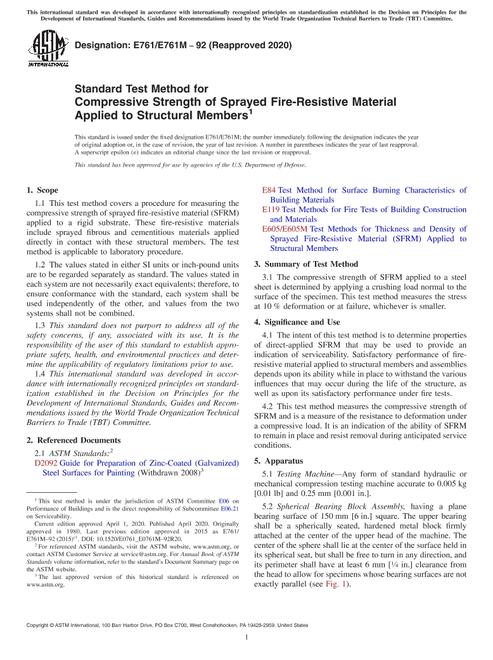
1.1 This test method covers a procedure for measuring the compressive strength of sprayed fire-resistive material (SFRM) applied to a rigid substrate. These fire-resistive materials include sprayed fibrous and cementitious materials applied directly in contact with these structural members. The test method is applicable to laboratory procedure.

1.2 The values stated in either SI units or inch-pound units are to be regarded separately as standard. The values stated in each system are not necessarily exact equivalents; therefore, to ensure conformance with the standard, each system shall be used independently of the other, and values from the two systems shall not be combined.

1.3 This standard does not purport to address all of the safety concerns, if any, associated with its use. It is the responsibility of the user of this standard to establish appropriate safety, health, and environmental practices and determine the applicability of regulatory limitations prior to use.

1.4 This international standard was developed in accordance with internationally recognized principles on standardization established in the Decision on Principles for the Development of International Standards, Guides and Recommendations issued by the World Trade Organization Technical Barriers to Trade (TBT) Committee.


File Size : 1 file , 79 KB
Note : This product is unavailable in Russia, Ukraine, Belarus
Number of Pages : 3
Published : 04/01/2020

History

ASTM E761/E761M-92(2023)
Published Date: 05/15/2023
Standard Test Method for Compressive Strength of Sprayed Fire-Resistive Material Applied to Structural Members
$15
ASTM E761/E761M-92(2020)
Published Date: 04/01/2020
Standard Test Method for Compressive Strength of Sprayed Fire-Resistive Material Applied to Structural Members
$18
ASTM E761-92(2011)
Published Date: 04/01/2011
Standard Test Method for Compressive Strength of Sprayed Fire-Resistive Material Applied to Structural Members
$15.6
ASTM E761-92(2005)
Published Date: 05/01/2005
Standard Test Method for Compressive Strength of Sprayed Fire-Resistive Material Applied to Structural Members
$15.6
ASTM E761-92(2000)
Published Date: 01/01/2000
Standard Test Method for Compressive Strength of Sprayed Fire-Resistive Material Applied to Structural Members
$15

Related products

ASTM E405-04(2018)
Published Date: 09/01/2018
Standard Test Methods for Wear Testing Rotary Operators for Windows
$12.6
ASTM E1775-24
Published Date: 09/01/2024
Standard Guide for Evaluating Performance of On-Site Extraction and Field-Portable Electrochemical or Spectrophotometric Analysis for Lead
$16.5
ASTM E987-88(2024)
Published Date: 10/01/2024
Standard Test Methods for Deglazing Force of Fenestration Products
$16.5

Best-Selling Products

SN-ISO/TR 10013:2001
Published Date: 01/14/2002
Guidelines for quality management system documentation
SN-ISO/TR 14062:2002
Published Date: 11/11/2002
Environmental management - Integrating environmental aspects into product design and development
SN-ISO/TR 14069:2013
Published Date: 06/11/2015
Greenhouse gases - Quantification and reporting of greenhouse gas emissions for organizations - Guidance for the application of ISO 14064-1
SN-ISO/TR 15489-2:2001
Published Date: 11/01/2008
Information and documentation — Records management — Part 2: Guidelines
SN-ISO/TR 15499:2012
Published Date: 07/01/2014
Biological evaluation of medical devices — Guidance on the conduct of biological evaluation within a risk management process
SN-ISO/TR 19083-1:2016
Published Date: 07/13/2023
Intelligent transport systems - Emergency evacuation and disaster response and recovery - Part 1: Framework and concept of operation