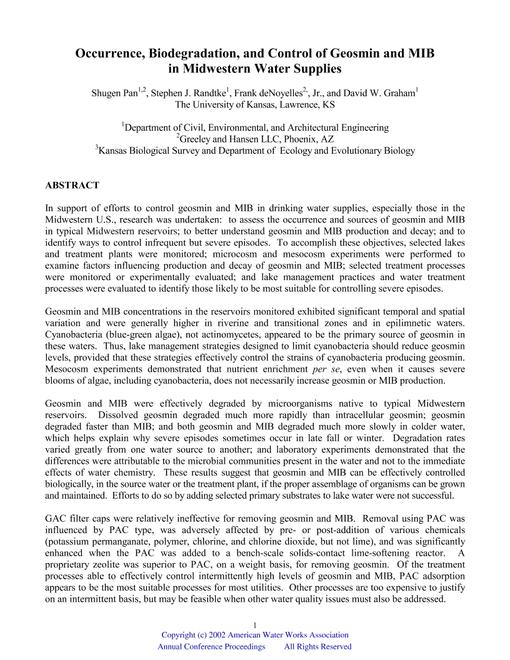
In support of efforts to control geosmin and 2-methylisoborneol (MIB) in drinking water supplies, especially those in the
Midwestern U.S., research was undertaken: to assess the occurrence and sources of geosmin and MIB
in typical Midwestern reservoirs; to better understand geosmin and MIB production and decay; and, to
identify ways to control infrequent but severe episodes. To accomplish these objectives, selected lakes
and treatment plants were monitored; microcosm and mesocosm experiments were performed to
examine factors influencing production and decay of geosmin and MIB; selected treatment processes
were monitored or experimentally evaluated; and, lake management practices and water treatment
processes were evaluated to identify those likely to be most suitable for controlling severe episodes.
Geosmin and MIB concentrations in the reservoirs monitored exhibited significant temporal and spatial
variation and were generally higher in riverine and transitional zones and in epilimnetic waters.
Cyanobacteria (blue-green algae), not actinomycetes, appeared to be the primary source of geosmin in
these waters. Thus, lake management strategies designed to limit cyanobacteria should reduce geosmin
levels, provided that these strategies effectively control the strains of cyanobacteria producing geosmin.
Mesocosm experiments demonstrated that nutrient enrichment per se, even when it causes severe
blooms of algae, including cyanobacteria, does not necessarily increase geosmin or MIB production.
Geosmin and MIB were effectively degraded by microorganisms native to typical Midwestern
reservoirs. Dissolved geosmin degraded much more rapidly than intracellular geosmin; geosmin
degraded faster than MIB; and both geosmin and MIB degraded much more slowly in colder water,
which helps explain why severe episodes sometimes occur in late fall or winter. Degradation rates
varied greatly from one water source to another, and laboratory experiments demonstrated that the
differences were attributable to the microbial communities present in the water and not to the immediate
effects of water chemistry. These results suggest that geosmin and MIB can be effectively controlled
biologically, in the source water or the treatment plant, if the proper assemblage of organisms can be grown
and maintained. Efforts to do so by adding selected primary substrates to lake water were not successful.
Granular Activated Carbon (GAC) filter caps were relatively ineffective for removing geosmin and MIB. Removal using powdered activated carbon (PAC) was influenced by PAC type, was adversely affected by pre- or post-addition of various chemicals
(potassium permanganate, polymer, chlorine, and chlorine dioxide, but not lime), and was significantly
enhanced when the PAC was added to a bench-scale solids-contact lime-softening reactor. A
proprietary zeolite was superior to PAC, on a weight basis, for removing geosmin. Of the treatment
processes able to effectively control intermittently high levels of geosmin and MIB, PAC adsorption
appears to be the most suitable processes for most utilities. Other processes are too expensive to justify
on an intermittent basis, but may be feasible when other water quality issues must also be addressed. Includes 12 references, tables, figures.
| Edition : | Vol. - No. |
| File Size : | 1
file
, 450 KB |
| Note : | This product is unavailable in Ukraine, Russia, Belarus |
| Number of Pages : | 20 |
| Published : | 06/16/2002 |