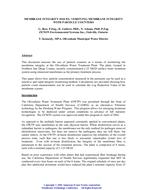
Drought issues consistently resurface each year throughout the United States. Seattle, Washington has felt the
impacts of water shortages, and in 2001 immediately preceded by the governor's declaration of a drought
emergency, a water-reuse pilot study was conducted. Focused partly at educating the public, the study also sought
performance data for a new membrane bioreactor (MBR) system developed by USFilter Jet Tech Products. Raw
sewage was prescreened, oxidized, filtered with a 0.08 um filter, and radiated with ultraviolet light before land
application.
Four months of pilot testing during the summer-fall season, demonstrated both hydraulic and water quality
performance capabilities of the system. Hydraulically, the membrane operated below a flux of 20 gfd (20oC) with
minimal fouling, less than 0.09 psi/day. Above 20 gfd, the fouling rate increased so that a chemical clean would be
necessary every 20 to 30 days. A chlorine CIP was performed once over the 4-month duration of the study and
shown to completely recover permeability. Stress testing the membrane revealed that the system could undergo
rapid changes in flux rates with no compromise in filtered water quality.
Filtered water quality met three of the four Washington State water reuse standards. The unmet standard, pathogenic
removal, was not directly evaluated, but based on two grab samples and membrane pore size, the effluent total
coliforms are expected to be less than 20 cfu/100 mL. Total suspended solids, turbidity, and biological oxygen
demand of the filtered water were all significantly less than state standards. Nutrient removal was not a targeted
goal, although 85% removal of ammonia was observed. Nitrate levels increased significantly, while phosphorus
levels in feed and filtered water were statistically no different. Includes 11 references, tables, figures.
| Edition : | Vol. - No. |
| File Size : | 1
file
, 1.4 MB |
| Note : | This product is unavailable in Ukraine, Russia, Belarus |
| Number of Pages : | 11 |
| Published : | 03/05/2003 |