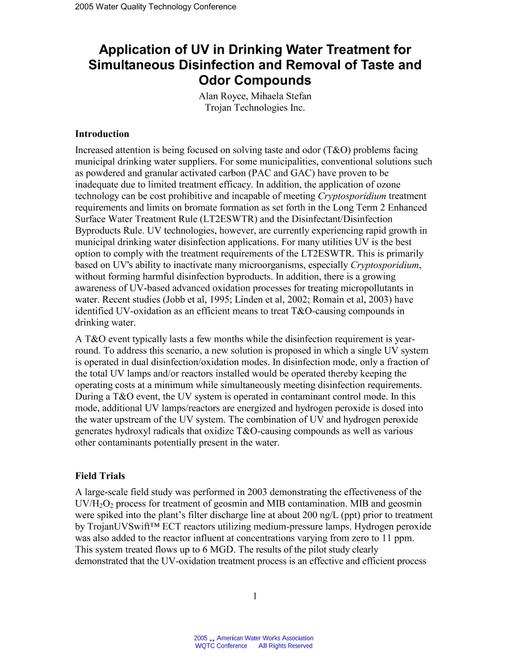
Increased attention is being focused on solving taste and odor (T&O) problems facing
municipal drinking water suppliers. For some municipalities, conventional solutions such
as powdered and granular activated carbon (PAC and GAC) have proven to be
inadequate due to limited treatment efficacy. In addition, the application of ozone
technology can be cost prohibitive and incapable of meeting Cryptosporidium treatment
requirements and limits on bromate formation as set forth in the Long Term 2 Enhanced
Surface Water Treatment Rule (LT2ESWTR) and the Disinfectant/Disinfection
Byproducts Rule. Ultraviolet (UV) technologies, however, are currently experiencing rapid growth in
municipal drinking water disinfection applications. For many utilities UV is the best
option to comply with the treatment requirements of the LT2ESWTR. This is primarily
based on UV's ability to inactivate many microorganisms, especially Cryptosporidium,
without forming harmful disinfection byproducts. In addition, there is a growing
awareness of UV-based advanced oxidation processes for treating micropollutants in
water. Recent studies (Jobb et al, 1995; Linden et al, 2002; Romain et al, 2003) have
identified UV-oxidation as an efficient means to treat T&O-causing compounds in
drinking water.
A T&O event typically lasts a few months while the disinfection requirement is year-round.
To address this scenario, a new solution is proposed in which a single UV system
is operated in dual disinfection/oxidation modes. In disinfection mode, only a fraction of
the total UV lamps and/or reactors installed would be operated thereby keeping the
operating costs at a minimum while simultaneously meeting disinfection requirements.
During a T&O event, the UV system is operated in contaminant control mode. In this
mode, additional UV lamps/reactors are energized and hydrogen peroxide is dosed into
the water upstream of the UV system. The combination of UV and hydrogen peroxide
generates hydroxyl radicals that oxidize T&O-causing compounds as well as various
other contaminants potentially present in the water.
A large-scale field study was performed in 2003 demonstrating the effectiveness of the
UV/H2O2 process for treatment of geosmin and MIB contamination. MIB and geosmin
were spiked into the plant's filter discharge line at about 200 ng/L (ppt) prior to treatment
by TrojanUVSwift™ ECT reactors utilizing medium-pressure lamps. Hydrogen peroxide
was also added to the reactor influent at concentrations varying from zero to 11 ppm.
This system treated flows up to 6 MGD. The results of the pilot study clearly
demonstrated that the UV-oxidation treatment process is an effective and efficient process
for the treatment of MIB and geosmin in drinking water to levels below the odor threshold
values and, in fact, below the analytical detection limits. Several sample sets were analyzed
for disinfection byproducts including haloacetic acids (HAAs), trihalomethanes (THMs)
and bromate and the results indicated that the UV/H2O2 process reduced THM and HAA
levels by an average of 25% and 12% respectively with no bromate formation. These
samples were also analyzed for assimilable organic carbon (AOC) levels before and after
treatment and the results indicate that no statistically significant increases were observed. Includes 3 references, figures.
| Edition : | Vol. - No. |
| File Size : | 1
file
, 190 KB |
| Note : | This product is unavailable in Ukraine, Russia, Belarus |
| Number of Pages : | 4 |
| Published : | 11/01/2005 |